
The Gold and Iron of Venice: From the Doge’s Palace to Torcello

Updated: 3 days ago

Prologue: Ten Years, 5,000+ Photos
In the summer of 2016 I spent three weeks in the Mediterranean. I flew into Venice, sailed seven ports on a cruise, and finished in Barcelona and Paris. I came home with 5,000+ photos and videos.
For ten years they sat in a folder.
The trip was not the problem. I was overwhelmed by the volume: thousands of frames, near-duplicates in long runs, Live Photos paired with stills, and no obvious place to start. Picking the best twenty is hard when there are five thousand candidates, so the folder stayed closed.
What finally worked was treating it like any other design problem: structure first, surface later. I stopped looking for favorite shots and sorted everything by date and location. Once the photos were in order, the trip turned out to have its own shape. The stops weren't all the same size. Some ports carried a full story on their own. Others only made sense paired with the stop before or after.
Nine Photo Essays
Venice and the lagoon islands
Dubrovnik and the Bay of Kotor
Corfu
Stromboli and Pompeii
Rome
Lucca and Pisa
The French Riviera
Barcelona
Paris
They follow the order of the trip, and a new one goes up every Saturday.
This Isn't a Travel Guide
The photos are ten years old, and some of what's in them has changed since. Where it matters, I'll say so. What follows is what the camera kept, edited down to the frames that hold up.
It starts where the trip did, in Venice, on the water.

The water taxi from the airport crosses open lagoon before the city appears, flat and low on the horizon, then narrows into canals between hospital walls and church facades.
Home base was the Hotel Ca' dei Conti, an old building with plenty of charm and very little interest in modern conveniences. The elevator is a converted chimney. It holds one person and no luggage, so bags go up separately and so do the guests. It's the kind of fix a building makes in a city where every wall is already spoken for.

Venice is the city most people already know how to photograph before they arrive. The Basilica in late sun, the Rialto after dark, a gondola under a footbridge. I took all of those, and a few of them earn their place here.


A City on Foot
The walking tour started where most of them do, in Piazza San Marco, under the two towers that set the square's vertical scale. The Campanile is a brick shaft almost a hundred meters tall. The original collapsed in 1902 and was rebuilt exactly as it was, where it was, and reopened in 1912, so the most photographed bell tower in Venice is younger than it looks. Across the square, the Torre dell'Orologio has kept time since the end of the 15th century. The dial is blue enamel and gold, marked with the signs of the zodiac, and two bronze figures on the roof strike the hours on a bell.
A few streets back from the square, the city narrows to the scale it was built at. Canals do the work streets do anywhere else, and the gondolas that fill postcards turn out to be traffic, queued nose to tail under the footbridges.
The Campanile of San Marco The Torre dell'Orologio Gondola traffic under a footbridge

The shop windows are part of the walk. Mask shops have covered every inch of their displays with papier-mâché faces, gilded, feathered and painted in patterns, stacked floor to ceiling behind the glass. The masks belong to Carnival, a tradition centuries older than Casanova, but the city trades on his legend all the same, down to the story of Casanova and his lover slipping away from a masquerade ball. City guides will embellish the tale, but his real escape was less romantic. In 1756 he broke out of the Piombi, the cells under the palace's lead roof.
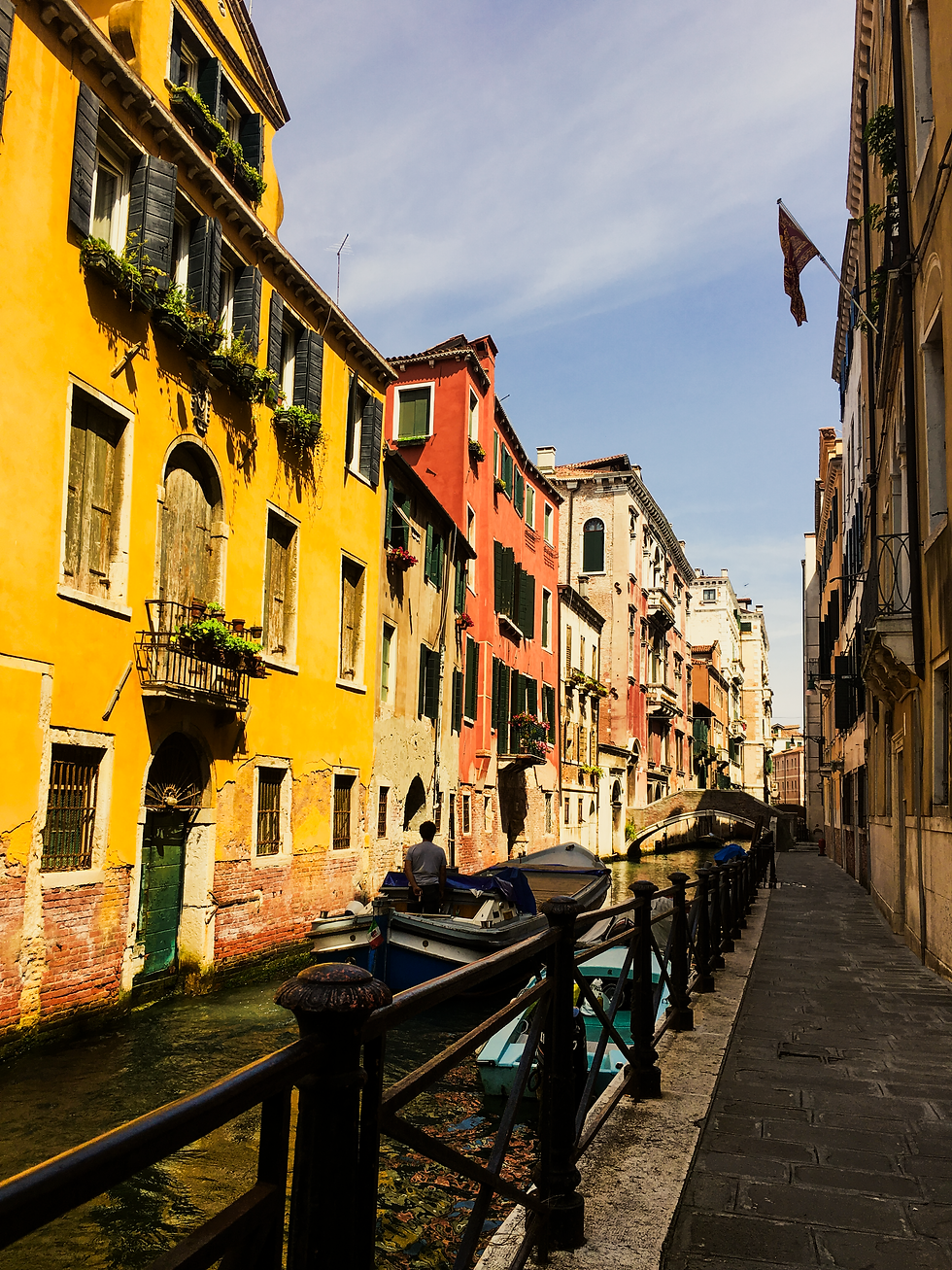
Farther out, the crowds thin. A quieter canal runs between ochre and red houses, with a fondamenta along one bank, boats tied up below the windows, and shutters instead of storefronts.
The Piazzetta at dusk The Rialto Bridge at night
At dusk the piazzetta turns to silhouette, and after dark the Rialto takes over the Grand Canal.
The Doge's Palace
Inside the Doge's Palace the ceilings do most of the talking. Most of what's on them went up after fires in the 1570s gutted the state rooms, when the Republic brought in Palladio, Tintoretto and Veronese to rebuild its image room by room. The palace was the seat of government, and the art was built to argue for it.
The Sala delle Quattro Porte, the anteroom where visitors waited to be received, shows the approach. The vault is white stucco worked into figures, garlands and scrolls, all edged in gold, with Tintoretto's painted panels set into the gaps. It was designed by Palladio.
The Sala delle Quattro Porte vault Ceiling panel, Sala delle Quattro Porte Titian, Doge Antonio Grimani Kneeling before Faith
On the wall of the same room, Doge Antonio Grimani kneels in armor before Faith, who stands in a burst of light holding a cross and chalice, with St. Mark on the left. The subject is devotion, but the placement is the message: a doge on his knees before the faith he governed in the name of, hung where every ambassador would stand and wait.
The Sala del Collegio goes further. This is where the doge and his cabinet received ambassadors, and the ceiling, painted by Veronese, turns from white to solid gold. Carved coffers frame allegories of the Republic's virtues, and Latin mottos sit in the cartouches between them. The one in my frame reads Numquam derelicta, never abandoned. Across the ceiling, another reads Reipublicae fundamentum, the foundation of the Republic.
The Sala del Collegio ceiling The Sala del Maggior Consiglio
Then the Sala del Maggior Consiglio, the Great Council hall, where the Republic's patrician class met as a body. The room is one of the largest in Europe, and the ceiling carries the scale the whole way across, one gilded frame after another over a floor wide enough to make a tour group look small. Tintoretto's Paradise covers the end wall. Veronese's Apotheosis of Venice is in the ceiling overhead.
Every surface is doing work. The quieter frames came from looking out instead of up: the city through 14th-century leaded glass, and the canal through the stone grille of the Bridge of Sighs, the last view the palace's prisoners had on their way across.
Leaded glass, Doge's Palace The view from the Bridge of Sighs
The Prisons and the Lion's Mouths
The bridge leads to the prisons, and the Republic had three kinds. The Pozzi (the Wells) were 18 cramped, damp cells at the lowest level of the palace, with no light or ventilation, and they often flooded with water from the lagoon. They held prisoners convicted of the most serious crimes against the state. The Piombi (the Leads) sat at the opposite extreme, in the attic directly under the palace's lead roof slabs. The lead made those small rooms freezing in winter and brutally hot in summer. They held high-profile and upper-class prisoners awaiting trial by the Council of Ten. Across the canal, on the far side of the Bridge of Sighs, the Prigioni Nuove held the crowded cells, too cramped to lie down, ceilings too low for a person to fully stand up. All three were torture by design.
What the photographs keep is the iron: hand-forged bars woven through one another in a grid, rust surfacing at every joint. A single bulb burns at the end of a corridor, just enough light to suggest what living in that darkness would have meant.
Hand-forged iron, Doge's Palace prisons A barred cell front A prison corridor, one bulb burning
Many of the accusations that filled those cells came in through the walls. The Republic's informant network ran through the Bocche di Leone, the lion's mouths: openings cut into the stone and carved as faces with open mouths, where anyone could drop a secret report. This one, set into the palace wall, reads: Denontie secrete contro chi occulterà gratie et officii o colluderà per nasconder la vera rendita d'essi. Secret denunciations against anyone who conceals favors and offices, or colludes to hide their true revenue.

Murano and Burano
The third day left the city behind. The last walk was a short one, along the waterfront to the boat, past the souvenir stalls under the umbrella pines.
The excursion started on Murano, at a glass furnace, with a crowd packed in around the demonstration and the kiln glowing orange at the back of the room.
Then north to Burano. Burano is known for lace and color. The houses are painted in blocks of saturated color, one flat hue per facade, and set side by side they read almost like a swatch strip. Above the square, the campanile of San Martino leans visibly off vertical. In the photo, the tilt is the first thing the eye catches, before the color.
A working boat on a Burano canal The leaning campanile of San Martino Burano's main street
Torcello Cathedral: Santa Maria Assunta
The last stop was Torcello and its cathedral, Santa Maria Assunta. Torcello was settled before Venice was. The cathedral was founded in 639 and rebuilt in the early 11th century, which makes it older than almost anything in the city I had spent the previous two days photographing.
Inside, the floor is inlaid marble in interlocking circles, and a screen of columns topped with painted panels divides the nave from the altar.

The apse is the reason to go. A tall, narrow Virgin and Child stands alone on a field of gold mosaic. Below her runs a row of apostles, and beneath them, a stepped stone bench curves around the apse where the clergy once sat. After the Doge's Palace, the contrast is hard to miss. In Venice, gold fills every inch. At Torcello, gold is the entire background, and a single figure carries the whole wall.
The apse mosaic, Santa Maria Assunta The synthronon and the bishop's seat A side chapel, Torcello cathedral
The side spaces are quieter still: bare brick, a small marble altar, one window, two hanging lamps. The light is low, and the photograph holds on to that.
The trip started on the water, and it ended there too: open lagoon in the early afternoon, heading back toward the city, the islands already down to a thin line of trees on the horizon.


Comments