
Above the Adriatic: Dubrovnik's Walls and the Road Over Kotor

Arriving by Water
The ship came into Dubrovnik a little after seven in the morning, past wooded islands and a coastline that drops straight into the sea. It docked at Gruž, the port north of the Old Town, under the cable-stayed span of the Franjo Tuđman Bridge.
The day was a Game of Thrones locations tour, which shaped what I photographed. A tour like that sells a fictional city, King's Landing. The photos kept catching the real one underneath it.
Trsteno, Before the City
The first stop wasn't Dubrovnik at all. Trsteno Arboretum sits a few miles up the coast. It was a Renaissance garden laid out by the Gučetić family, one of Dubrovnik's noble houses, and it was established by 1492, when an aqueduct was built to water it.
The series used it as the palace gardens of King's Landing in its third and fourth seasons — fans of the show know it as "Sansa's Garden."
What the camera found was shade. Gravel paths run under a closed canopy, green on every side, the light coming through in patches. At the end of one path, a grotto fountain stands over a still pool, the figures half hidden in stone and fern.
The Red Keep Is a Fort Called Lovrijenac
From the road above the city, Dubrovnik shows its whole plan at once: a walled oval on a rock, terracotta roofs packed inside, the sea on three sides.
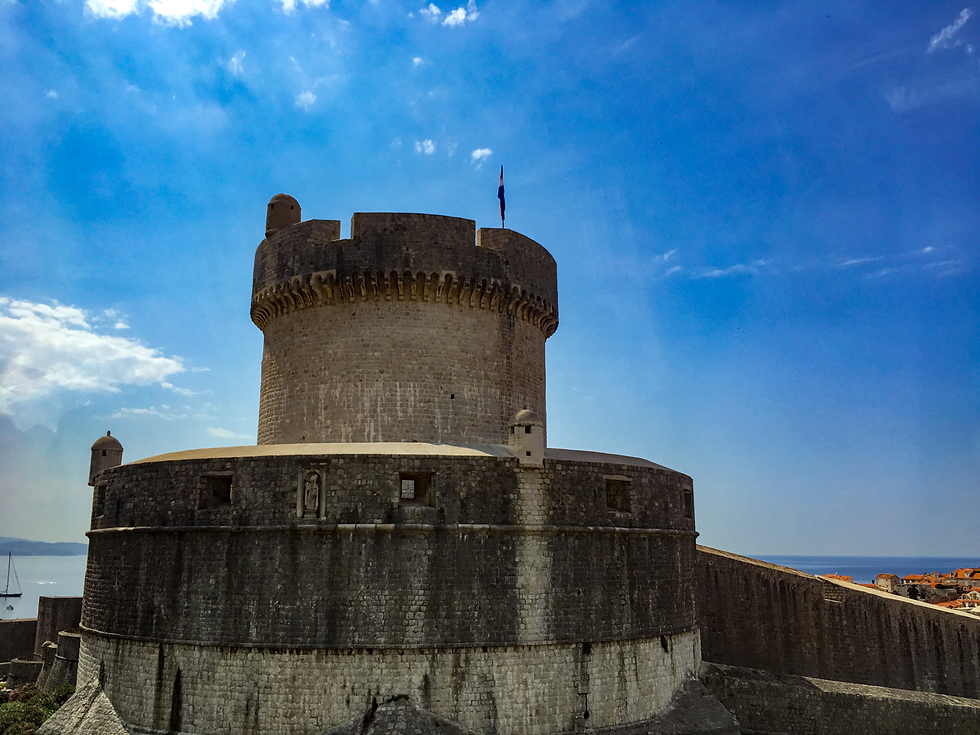
The round tower at the high corner of the walls is Minčeta, completed in 1464 to a design by Juraj Dalmatinac. In the series, it stood in for the House of the Undying in Qarth.
The Red Keep was a different building, outside the walls entirely. Lovrijenac, the fortress of St. Lawrence, stands on a rock 37 meters above the sea, across a small inlet from the western gate. Below it, the water in the cove is a turquoise that barely looks real in the photos.

The best view of Dubrovnik turns out to be from Lovrijenac, looking back. From its ramparts the city walls run the full length of the frame, nearly two kilometers of stone around the Old Town, with Fort Bokar at the corner and the roofs stacked behind them.

Inside Dubrovnik's Old Town
The way in is the Pile Gate, and the first thing past it is Onofrio's Great Fountain, a domed stone drum with water running from carved faces around its base. From there the streets narrow to stone lanes between tall facades, shuttered and worn smooth at the corners.
The Jesuit Stairs climb from a small square in a baroque sweep, broad and shallow — this was the filming location for Cersei Lannister's "Walk of Shame." Farther on, pigeons lift off over Gundulić Square, and the dome of St. Blaise rises over the next square.
The ship left at sunset. The last frames from Dubrovnik are islands going dark against an orange sky above Gruž.

Into the Bay of Kotor
The next morning the ship turned in from the open sea and kept going inland. The Bay of Kotor winds between mountains for miles, and by the time the ship docked, the water was enclosed on every side, with rock walls rising straight up from the shoreline.
The Road Over Kotor
The day in Montenegro was a booked jeep tour into the mountains, and it started with the road. Between Kotor and the pass at Krstac, it climbs the mountainside in 25 hairpin turns. It was built between 1879 and 1881, after the Congress of Berlin recognized Montenegro as an independent state.
Every turn opens the same view a little higher. The bay narrows to a blue channel below, Kotor shrinks to a cluster of roofs, and the cruise ship sits at the waterline like a toy.
At the top, the land changes completely. Above the switchbacks there's open limestone country with wildflowers on the rock, and a view in the other direction, out over the coast to the sea. At one overlook, a green vintage off-roader sat parked at the edge, facing the drop.
The tour went on along dirt tracks through high pastures. These are wide green bowls between the peaks, with dry-stone walls running across the grass and almost no one in sight.
Njeguši
Njeguši is a village on the high plateau, the birthplace of the Petrović-Njegoš dynasty that ruled Montenegro. Today it's known for smoked meats, and the stop was about pršut, the dry-cured ham. The frames from the village are a quiet street of low houses under the peaks.

Kotor From Below
Back down the serpentine, Kotor looks different at street level. Its walls don't stop at the edge of town. They climb the mountain behind it, zigzagging up the slope above the roofs, and the old town sits tight between the rock and the water. Kotor and its bay were listed together as a UNESCO World Heritage Site in 1979.
From the ship's deck in the afternoon, the whole town fit in one frame: orange roofs, the walls climbing, and the gray mountain filling everything above.

Leaving the Bay
The ship left in the late afternoon under heavy cloud, back out through the bay the way it came, past Perast and the narrows. The mountains went from green to gray as the light dropped.
By the evening, the ship was off Corfu.


Comments